
Picture this: you have spent three months scouting timber trails, tuning broadheads, and climbing into frosty morning treestands. Just as shooting light breaks through the timber, a mature buck steps into your thirty-yard lane. You draw your bow back, anchor at your jawline, and suddenly your peep rotates sideways. You can’t see your pins. A worn or stretched bowstring costs you accuracy and confidence right when it matters most.
To help bowhunters and traditional archers keep their rigs shooting dead-center, our Target & Outdoor Sports Desk evaluated the premier compound and recurve bowstrings for 2026 across zero-creep stability, serving durability, quiet release, and velocity output. In this review guide, whether you need a pre-stretched compound harness that stops peep twist or a handcrafted Flemish twist string for your traditional recurve, we’ve ranked the top options on the line. Be sure to pair your new string with a glare-resistant aperture from our best peep sights guide, and follow our tutorial on how to paper tune a compound bow to lock in bullet holes.
Comparison Table: Best Options at a Glance
| Model | Product & Award | Key Spec / Category | Tier | Action |
|---|---|---|---|---|

|
Best Overall Pick 60X Custom Bowstrings BCY 452X Replacement Compound String |
BCY 452X Blend / Zero Peep Rotation | $$$ | Check Price » |

|
Best for Zero Break-In Vapor Trail VTX Compound Bow String |
Proprietary VTX Fiber / No Peep Twist | $$$ | Check Price » |

|
Best Factory Replacement Zebra Bow Strings Trophy Compound Cable & String |
Pre-Conditioned BCY 452X / Mathews & Mission | $$$ | Check Price » |

|
Best for Modern Recurves LWANO D97 Flemish Twist Fast Flight Bow String |
Dyneema D97 Fiber / Hand-Twisted Flemish | $$ | Check Price » |

|
Best for Wooden Recurves SAS Southland Archery Supply B-55 Dacron Traditional String |
100% B-55 Polyester / Gentle on Limb Tips | $ | Check Price » |

|
Best Serving Maintenance BCY 3D Bowstring End Serving Material & Thread |
120-Yard Spool / .017 Braided Dyneema | $ | Check Price » |
🎯 Target & Range Notes: AMO Length vs. Actual String Length — The 4-Inch Recurve Rule
Ordering the wrong length string is the most common mistake traditional archers make. You don’t want to end up with a useless bowstring. When shopping for recurve strings, you’ll see two numbers: AMO Bow Length and Actual String Length. Under Archery Manufacturers Organization (AMO) standards, a recurve bow labeled 62 inches AMO requires a string that measures 58 inches under tension. That’s four inches shorter than the bow’s AMO mark. Longbows take a string three inches shorter than marked AMO length. Compound strings must match exact factory specs down to sixteenths of an inch. Always verify whether a listing states AMO length or actual length before ordering so your brace height tunes cleanly.
Detailed Product Reviews & Evaluations
60X Custom Bowstrings BCY 452X Replacement Compound String
Price Tier: $$$ | Key Spec: BCY 452X Blend / Zero Peep Rotation
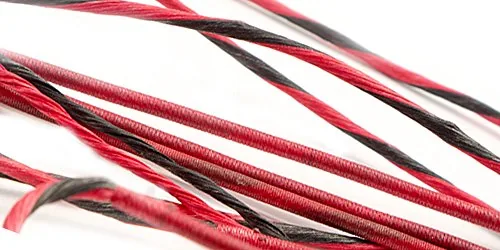
Few gear failures ruin a hunt faster than a twisted peep sight or stretched cable during peak rut. You don’t want to lose a buck over creeping fibers. The 60X Custom BCY 452X string set solves this problem through five-stage tensioning. By stretching each bundle under heavy sustained load before serving, 60X wipes out the annoying break-in creep that throws off cam timing. It’s built with 67% SK75 Dyneema and 33% Vectran. This blend delivers blazing arrow speeds. It won’t shift when temperatures swing from warm afternoons to freezing mornings. Its tightly burnished 3D end servings seat cleanly into cam tracks without bunching up.
Bowhunters and 3D tournament archers consistently praise how fast this string settles into place. Field shooters report dead-straight peep alignment within ten warmup shots. You won’t see rotation even after hundreds of shots. The Vectran blend feels crisp on release. Archers note that it’s important to keep the strands waxed so the fibers don’t dry out over long seasons.
✓ What Works Well
- Proprietary 5-stage pre-stretching completely eliminates break-in creep
- BCY 452X Vectran blend stops peep sight rotation dead in its tracks
- Tightly wrapped 3D servings resist separation on aggressive cam rollovers
- Remarkable speed consistency through wide autumn temperature shifts
⚠ What to Keep in Mind
- Requires precise bow specs (string and cable lengths) when ordering
- Slightly stiffer shot feel than pure polyethylene traditional strings
Bottom Line: The premier replacement string for modern compound setups, delivering zero peep twist and rock-solid cam timing right out of the package.
Vapor Trail VTX Compound Bow String
Price Tier: $$$ | Key Spec: Proprietary VTX Fiber / No Peep Twist
When opening weekend is days away, you can’t afford to shoot two hundred arrows just to settle a string. Vapor Trail built their VTX synthetic fiber specifically to kill break-in lag. From your very first shot, the string stays settled at spec length. It doesn’t stretch. The material naturally dampens string buzz, giving you a whisper-quiet release so whitetails won’t jump your string. The center serving fits modern nock throats with great snap. You’ll get clean arrow departure on every draw.
Shooters who switch to Vapor Trail love the easy drop-in setup. Peep sights stay square from shot one without extra twists at the bow press. Hunters in wet mountain regions confirm the VTX fiber doesn’t soak up water. It holds steady chronograph numbers whether you’re shooting dry foam or trekking through heavy rain.
✓ What Works Well
- Virtually zero break-in period required before setting final sight pins
- Proprietary VTX synthetic blend softens shot noise and residual vibration
- Excellent center serving tension fits standard small and large groove nocks
- Exceptional moisture resistance prevents weight gain in foul weather
⚠ What to Keep in Mind
- Proprietary thread blend is harder to source locally for emergency repairs
- Premium pricing sits at the upper tier for replacement compound strings
Bottom Line: An outstanding choice for bowhunters needing immediate drop-in accuracy with zero break-in lag before opening weekend.
Zebra Bow Strings Trophy Compound Cable & String
Price Tier: $$$ | Key Spec: Pre-Conditioned BCY 452X / Mathews & Mission
If you shoot a Mathews or Mission bow, matching original factory specs protects your cam timing. Zebra Trophy strings use pre-conditioned BCY 452X material with a patented counter-twist layout. This design balances tension across every strand bundle. Individual fibers don’t carry uneven loads as the cams roll. The end servings have reinforced loops that cushion post friction. They won’t separate under high let-off cams.
Mathews owners trust Zebra because string lengths match factory specs right to the millimeter. You won’t need endless yoke adjustments to square up your cams. Technicians note that bows tune quickly upon installation. A few archers mention the center serving feels snug on thin target nocks, but it beds down after twenty shots.
✓ What Works Well
- Factory-exact fit for Mathews, Mission, and popular dual-cam hunting bows
- Patented counter-twist tensioning balances stress evenly across bundles
- Reinforced post loops shield against friction on sharp cam mounting pins
- Maintains factory axle-to-axle specs and draw cycle geometry
⚠ What to Keep in Mind
- Color options are more limited than boutique custom string builders
- Center serving can be tight on compact Asian-import target nocks
Bottom Line: The definitive factory-spec replacement for Mathews and dual-cam shooters who want predictable timing and OEM build quality.
LWANO D97 Flemish Twist Fast Flight Bow String
Price Tier: $$ | Key Spec: Dyneema D97 Fiber / Hand-Twisted Flemish
Traditional archers shooting modern recurves with reinforced limb tips want speed without harsh hand shock. The LWANO D97 Flemish Twist string pairs genuine Dyneema D97 fibers with hand-braided Flemish splices. These braided loops taper into limb grooves smoothly. They dampen limb slap for a quiet, low-vibration shot. Compared to sluggish Dacron cords, you’ll gain five to ten feet per second in arrow speed. That flattens your trajectory on long 3D target shots.
Traditional bowhunters love how quiet this string shoots right out of the package. Archery range regulars note that the loops sit deep in recurve string tracks. You won’t get buzzing or rattles. Shooters point out that D97 has low stretch, so you shouldn’t mount it on vintage bows with raw wooden tips.
✓ What Works Well
- High-modulus Dyneema D97 adds noticeable arrow speed over Dacron
- Hand-twisted Flemish splices nest cleanly into recurve limb grooves
- Significantly quieter shot profile with reduced limb vibration
- Generous bundle options match both light hunting and target draw weights
⚠ What to Keep in Mind
- Must NOT be used on vintage wooden recurves lacking reinforced limb tips
- Requires initial brace height monitoring as the Flemish braid sets
Bottom Line: The top performance upgrade for modern traditional archers wanting flatter trajectories, quiet release, and classic Flemish aesthetics.
SAS Southland Archery Supply B-55 Dacron Traditional String
Price Tier: $ | Key Spec: 100% B-55 Polyester / Gentle on Limb Tips
Shooting a vintage recurve or beginner takedown bow requires elastic string fibers to protect limb tips. The SAS B-55 string is spun from 100% polyester. It provides the gentle flex of classic Dacron while resisting abrasion much better than older B-50 cords. Its built-in stretch cushions limb rebound on release. It won’t split delicate wood tips on vintage recurves. The center serving is wound neatly and fits standard brass nocks cleanly.
Archery coaches and club instructors consider the SAS B-55 the most reliable budget workhorse string you can buy. Novice archers appreciate the forgiving shot feel. It smooths out messy finger releases. You’ll notice natural stretch during the first fifty shots, so you’ll want to add a few twists to keep your brace height dialed in.
✓ What Works Well
- Safe for all vintage wooden bows, entry takedowns, and non-reinforced tips
- Forgiving shot dynamics soften hand shock for developing archers
- B-55 polyester resists abrasion and fuzzing better than older B-50 blends
- Exceptional budget value for school teams, camps, and backup bow cases
⚠ What to Keep in Mind
- Exhibits natural stretch requiring brace height adjustment during break-in
- Slower arrow velocities compared to modern low-stretch Dyneema cords
Bottom Line: The safest, most forgiving replacement string for vintage recurves, youth takedowns, and budget traditional setups.
BCY 3D Bowstring End Serving Material & Thread
Price Tier: $ | Key Spec: 120-Yard Spool / .017 Braided Dyneema
Even the finest custom bowstring will fail if protective serving thread unravels around cam grooves. BCY 3D end serving is the gold standard thread used by pro archery shops. Spun from three-ply Dyneema with a slim .017-inch diameter, it packs tightly around string bundles without adding excess weight. Its round profile grips fibers firmly. It won’t slip on sharp cam posts. Keeping a spool in your gear bag lets you tie peep sights and repair loose servings in minutes.
DIY archers and bow mechanics regard BCY 3D as a shop staple. Reviews highlight how cleanly the thread feeds through standard serving jigs without binding up. It flattens slightly under wrapping tension, creating a smooth, slick surface that won’t grab cable slides or nock grooves.
✓ What Works Well
- Industry-standard serving thread chosen by professional bow builders
- Slim .017 diameter lays flat and packs tightly around strand bundles
- Resilient Dyneema construction resists slicing and abrasion on sharp cams
- Versatile thread for end servings, peep sight ties, and drop-away rest cords
⚠ What to Keep in Mind
- Requires a dedicated serving tool or jig to achieve consistent wrapping tension
- Thread spool only—does not include bow press or serving jig hardware
Bottom Line: An essential maintenance supply for every serious archer’s toolkit, perfect for emergency field repairs and professional serving jobs.
🎯 Target & Range Notes: Pure Wax vs. Silicone Blends — How to Stop Fraying and Separation
Bowstrings face extreme friction, moisture, and dust every time you shoot. To stop fibers from fraying, wax your bowstring every two to three weeks of steady shooting. Pure beeswax provides good waterproofing, but it gets stiff in freezing weather. Modern synthetic waxes blended with silicone soak deep into fiber bundles quickly. Rub the stick along exposed strands—don’t wax the servings that wrap around cams or arrow nocks. Wrap a piece of soft leather around the string and slide it briskly up and down. Friction heat melts the wax right into the strand core, wiping away excess residue that attracts dirt.
Other Bow Strings We Evaluated (And Why They Missed the Cut)
We evaluated several other widely used replacement strings and materials during our market evaluation. While capable for casual shooting, each was edged out by our top award picks due to specific engineering trade-offs in strand stretch, custom build turnaround time, or vibration dampening:
Why it missed the cut: A dependable, inexpensive loop string for backyard target shooting, but lacks the hand-twisted Flemish splice dampening that softens hand shock on modern recurves.
Why it missed the cut: Features peerless fiber balancing and zero peep rotation, but custom order lead times can exceed three weeks compared to readily available pre-served sets.
Why it missed the cut: A well-constructed Dacron string for entry recurves, but exhibits noticeable stretch across the first 150 shots before brace height fully stabilizes.
5-Pillar Buyer’s Guide & Technical Selection Playbook
Before replacing your bowstring or cable set, evaluate your setup across these five foundational engineering and maintenance pillars so you get the right materials on the first try:
Pillar 1: String Materials & Fiber Engineering (BCY 452X vs. Dyneema D97 vs. B-55 Dacron)
The heart of any bowstring is its underlying raw synthetic fiber. Understanding how modern materials differ prevents equipment mismatch and catastrophic limb failure. For modern compound bows, BCY 452X and BCY-X blends represent the industry benchmark. Made from a composite of ultra-high-molecular-weight polyethylene (Dyneema) and liquid crystal polymer (Vectran), these fibers have zero practical creep. Vectran has zero elasticity, which prevents the string from elongating under sustained draw weight, while Dyneema adds tensile toughness and abrasion resistance.
For modern traditional recurve bows with reinforced limb tips, Dyneema D97 and Fast Flight Plus materials deliver unmatched speed and kinetic energy transfer. These low-stretch fibers generate flat arrow flight paths and instant limb snap. However, vintage wooden recurves and entry-level bows lacking phenolic tip laminations require B-55 or B-50 Dacron polyester strings. Dacron has natural elasticity that stretches roughly two to three percent at full draw. That built-in stretch cushions the limb tips upon release, preventing limb splitting and delamination.
Pillar 2: Flemish Twist vs. Endless Loop: Which Construction Fits Your Bow?
Traditional bowstrings are constructed using either an endless loop or a Flemish twist design. Endless loop strings are created by winding a continuous strand around two jig posts, with protective thread served over the end loops. Endless loop strings deliver ultra-consistent strand tension and uniform diameter, making them the preferred choice for Olympic recurve competitors and target shooters who prioritize absolute mechanical precision.
Flemish twist strings, by contrast, feature hand-braided splices where the individual fiber bundles are counter-twisted back into the main body of the string. The braided loops naturally taper into limb string grooves, creating a softer acoustical release with less hand vibration. Bowhunters overwhelmingly prefer Flemish strings because they shoot noticeably quieter in timber and allow quick field adjustments—simply twisting or untwisting the string changes brace height effortlessly.
Pillar 3: Strand Count, Arrow Nock Fit & Center Serving Diameter
Strand count determines both the physical strength of your string and how your arrow nock clips onto the center serving. Traditional recurve strings typically utilize twelve to sixteen strands. A lighter twelve-strand string increases arrow speed by reducing string mass, but it is best reserved for bows pulling forty pounds or less. Heavier draw weights (forty-five to sixty pounds) require fourteen to sixteen strands for safety and structural stability.
The combination of your strand count and the thickness of the center serving thread determines nock fit. Your arrow nock should snap onto the center serving with a crisp, audible click, yet slide freely along the serving without slipping off under its own weight. A nock that fits too tightly creates friction on release, robbing velocity and causing erratic vertical arrow flight. A nock that is too loose can slip during draw, risking a dry fire.
Pillar 4: Creep vs. Stretch: Preventing Cam Timing Shift & Peep Sight Rotation
Archers often confuse temporary stretch with permanent creep, but the engineering distinction is critical. Temporary stretch is the elastic elongation of a string under draw tension that immediately returns to baseline length upon release. Creep, by contrast, is permanent non-recoverable elongation caused by fiber bundles slipping or uncoiling under sustained pressure.
On a modern compound bow, even a sixteenth of an inch of string creep throws off cam synchronization, alters draw stop timing, and rotates your peep sight out of alignment with your sight pins. High-end custom strings employ pre-stretching protocols exceeding three hundred pounds of sustained tension. This seats the bundles permanently before the servings are wound, ensuring your peep sight stays perfectly square to your eye throughout the entire season.
Pillar 5: String Waxing, Rail Care & Replacement Schedules
A well-maintained compound bowstring lasts approximately two to three seasons or roughly 2,500 to 3,000 shots. However, exposure to hot vehicle trunks, abrasive dirt, and ultraviolet light accelerates fiber breakdown. Replace your string immediately if you notice frayed or broken strands, serving separation that exposes bare string bundles under cam posts, or persistent peep rotation that cannot be tuned out.
Wax your string bundles whenever the fibers feel dry or begin to show light surface fuzz. Apply a thin layer of wax, burnish it thoroughly with leather to penetrate the core, and wipe away surface residue. Never use sharp metal knives to strip old wax, and store your bow in a climate-controlled room away from high heat and direct sunlight.
Frequently Asked Questions (FAQ)
How often should you replace your compound bow strings and cables?
Most bowhunters and recreational archers should replace their string and cable set every two to three years, or every 2,500 to 3,000 shots. Hardcore hunters who shoot year-round in extreme heat, rain, or dust should replace them annually. Always inspect the serving around cam tracks and the d-loop attachment area; if the serving separates and exposes bare, frayed fibers, replace the set immediately regardless of age.
Can you shoot Fast Flight or D97 strings on an older vintage recurve bow?
No. Never install low-stretch synthetic strings (Fast Flight, D97, or BCY blends) on vintage wooden recurves or bows lacking modern reinforced limb tips. Modern fibers have virtually no stretch, transferring immense shock energy directly into the limb tip upon release. On vintage bows with simple wooden overlays, this shock can shear the limb tips clean off. Stick to 100% Dacron B-50 or B-55 strings for older bows.
Why is my peep sight rotating at full draw, and how do I fix it?
Peep rotation happens when the two strand bundles dividing the peep sight experience uneven tension, or when the bowstring suffers from break-in creep. You can correct minor peep twist by pressing the bow and adding or removing a half-twist to the top or bottom loop. High-quality pre-stretched strings (like BCY 452X) virtually eliminate this issue by balancing internal strand tension before the servings are applied.
How do I determine the correct string length for my compound bow?
Compound bow string and cable lengths are listed on the manufacturer spec sticker located on the inside of the lower bow limb. This label displays exact lengths for the main string, control cable, and buss (yoke) cable down to a sixteenth of an inch. If the sticker has worn off, consult the manufacturer’s official tune chart online by matching your bow model, year, and cam designation.