
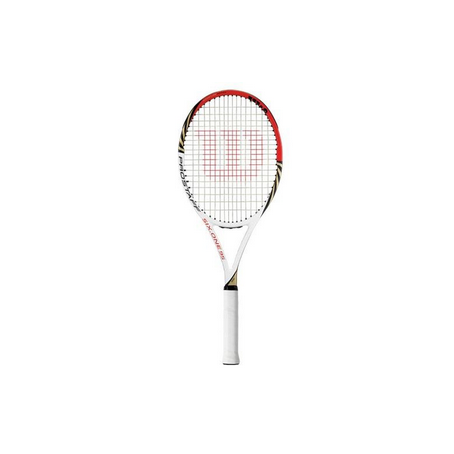
Master Comparison Table: Best Tennis Racquets
| Model | Product & Award | Key Spec / Category | Tier | Action |
|---|---|---|---|---|

|
Best Overall for All-Around Play & Arm Comfort Wilson Clash 100 V3 |
100 sq in Head | 16×19 Pattern | FreeFlex Carbon Weave | $$$$ | Check Price » |

|
Best for Spin & Baseline Aggression Babolat Pure Aero Team |
100 sq in Head | Aeromodular3 Frame | NF²-Tech Flax Dampening | $$$$ | Check Price » |

|
Best Power & Explosive Serves Babolat Pure Drive (11th Gen) |
100 sq in Head | HTR System Carbon | FSI Power String Spacing | $$$$ | Check Price » |

|
Best Speed & Precision Control HEAD Speed MP (Auxetic 2.0) |
100 sq in Head | Auxetic 2.0 Construction | Speed Beam Cross-Section | $$$$ | Check Price » |

|
Best Lightweight Power for Intermediate Players Wilson Hyper Hammer 5.3 |
110 sq in Head | Hyper Carbon Frame | Hammer Balance Weighting | $$ | Check Price » |

|
Best Oversized Pick for Beginners & Seniors HEAD Ti S6 Titanium |
115 sq in Oversized Head | Titanium & Graphite Composite | Ultra-Light 8.9 oz | $$ | Check Price » |
🏃 Elena’s Trackside Notebook: Elena’s Trackside Notebook: Head Size & Swingweight Physics
When evaluating modern tennis racquets, head size and swingweight determine how the frame interacts with your swing mechanics. A 100-square-inch head has become the modern benchmark because it combines forgiving sweet spot area with high-level directional control. Midplus frames (98 sq in) reward advanced players who generate their own power and demand surgical placement, while oversized hoops (105 to 115 sq in) provide massive trampoline assistance for compact, slower strokes. Pay close attention to swingweight rather than just static scale weight—a head-heavy light frame will feel surprisingly substantial once moving through the hitting zone.
Detailed Reviews of the Best Tennis Racquets
Wilson Clash 100 V3
Price Tier: $$$$ | Key Spec: 100 sq in Head | 16×19 Pattern | FreeFlex Carbon Weave
The Wilson Clash 100 V3 continues to lead the modern racquet landscape by pairing exceptional frame flexibility with torsional stability. Wilson’s proprietary FreeFlex carbon mapping bends dynamically along traditional horizontal and vertical swing planes, granting players plush ball pocketing without the erratic launch angles of older flexible frames. For club competitors who manage forearm tightness or elbow sensitivity, the Clash 100 V3 absorbs heavy ball impacts smoothly while delivering clean depth from both wings.
✓ What Works Well
- Plush ball dwell time significantly softens shock on off-center mishits
- Patented carbon mapping delivers high flex without losing directional control
- Generous sweet spot supports rapid baseline recovery during defensive scrambling
⚠ What to Keep in Mind
- Muted impact feedback requires adjustment for players used to ultra-stiff frames
- Advanced flat-ball hitters may seek higher static mass for terminal smash speed
Bottom Line: The premier benchmark for all-court players who demand tour-level depth and forgiveness with unmatched arm protection.
Babolat Pure Aero Team
Price Tier: $$$$ | Key Spec: 100 sq in Head | Aeromodular3 Frame | NF²-Tech Flax Dampening
Engineered for maximum rotational speed, the Babolat Pure Aero Team features an Aeromodular wing-profile cross-section that cuts through air friction effortlessly. Natural flax fiber inserts integrated into the throat damp high-frequency string buzzing while retaining the explosive rebound Babolat is famous for. The open string bed bites into the felt covering to generate heavy arching topspin dips that kick aggressively off the court surface.
✓ What Works Well
- Aerodynamic throat profile produces exceptional head speed on brushing swing paths
- Flax fiber inserts in the throat filter harsh vibrations on off-center returns
- Lighter Team spec allows rapid reflex volleys and fast defensive recoveries
⚠ What to Keep in Mind
- Lighter static weight requires clean swing acceleration against heavy incoming pace
- High launch angle demands deliberate topspin mechanics to avoid sailing long
Bottom Line: A high-spin weapon crafted for aggressive baseliners looking to drive opponents deep with heavy topspin kicks.
Babolat Pure Drive (11th Gen)
Price Tier: $$$$ | Key Spec: 100 sq in Head | HTR System Carbon | FSI Power String Spacing
The Babolat Pure Drive remains the gold-standard power frame for players seeking blistering serve speeds and lethal put-away winners. Its High Torsional Rigidity (HTR) carbon lay-up wraps the hoop tightly, preventing frame twisting on full-velocity baseline groundstrokes. Diamond-shaped grommet holes and optimized string spacing provide massive trampoline rebound, turning compact counter-punches into deep penetrating line drives.
✓ What Works Well
- Explosive energy return yields effortless serve velocity and overhead power
- Rigid graphite chassis provides rock-solid stability against heavy heavy-hitting opponents
- FSI Power string spacing widens the sweet spot for crisp off-center depth
⚠ What to Keep in Mind
- Stiffer beam construction can feel demanding on players with prior tendonitis
- Compact swings require soft hands when touching delicate drop shots at the net
Bottom Line: The definitive power platform for aggressive baseliners and big servers wanting immediate put-away punch.
HEAD Speed MP (Auxetic 2.0)
Price Tier: $$$$ | Key Spec: 100 sq in Head | Auxetic 2.0 Construction | Speed Beam Cross-Section
HEAD’s Speed MP balances rapid maneuverability with pinpoint directional targeting. Updated with Auxetic 2.0 internal carbon fibers placed in both the yoke and carbon handle bridge, the racquet widens and contracts dynamically to give direct tactile impact feedback. The aerodynamic Speed Beam cross-section combines the surgical precision of classic player frames with the rapid acceleration of modern aerodynamic spin sticks, letting players dictate tempo from all court positions.
✓ What Works Well
- Auxetic 2.0 construction provides crisp, communicative feedback on ball contact
- Versatile balance point glides effortlessly between baseline grinding and net volleys
- Tight directional control prevents floating on offensive transition drives
⚠ What to Keep in Mind
- Demands active footwork and prepared swing mechanics to generate finishing pace
- Lacks the brute trampoline assistance of wider-beam power racquets
Bottom Line: The ultimate precision tool for complete all-court competitors who transition fluidly between offense and defense.
Wilson Hyper Hammer 5.3
Price Tier: $$ | Key Spec: 110 sq in Head | Hyper Carbon Frame | Hammer Balance Weighting
A legendary fixture in recreational tennis, the Wilson Hyper Hammer 5.3 delivers immense power through an ultra-lightweight chassis. By engineering the frame with aerospace Hyper Carbon and concentrating mass toward the racquet head (Hammer Technology), Wilson created a racquet that swings effortlessly while packing enough momentum to return balls deep. The generous 110-square-inch hoop provides a forgiving sweet spot that rewards intermediate players developing their rallying consistency.
✓ What Works Well
- Head-heavy balance produces surprising plow-through without taxing forearm fatigue
- Oversized 110-inch hitting area forgives late contact points on fast incoming serves
- Ultra-lightweight design enables swift overhead preparation and reaction volleys
⚠ What to Keep in Mind
- Head-heavy distribution requires adjustment during rapid baseline touch rallies
- Open string pattern on an oversized head can launch balls if swings become erratic
Bottom Line: A proven, value-packed power performer for recreational competitors wanting effortless depth and maneuverability.
HEAD Ti S6 Titanium
Price Tier: $$ | Key Spec: 115 sq in Oversized Head | Titanium & Graphite Composite | Ultra-Light 8.9 oz
The HEAD Ti S6 remains one of the best-selling racquets in tennis history for a reason: it delivers effortless depth with practically zero arm strain. Weighing just 8.9 ounces strung, its featherweight titanium-graphite weave allows players with compact or slower swing speeds to generate deep, penetrating groundstrokes. The massive 115-square-inch hitting zone virtually eliminates mishits, making it an ideal companion for beginners, doubles specialists, and senior league players.
✓ What Works Well
- Massive 115-square-inch sweet spot offers maximum forgiveness across the string bed
- Titanium weave yields an ultra-lightweight frame that swings effortlessly for doubles
- Generates high ball clearance and effortless depth with short, compact strokes
⚠ What to Keep in Mind
- Extra-large head and light mass offer limited stability against heavy tournament pace
- Too powerful for athletic players who take full, aggressive vertical swings
Bottom Line: The undisputed standard for beginners, senior league competitors, and doubles players seeking unmatched sweet spot area.
🏃 Elena’s Trackside Notebook: Elena’s Maintenance Notes: String Tension & Multifilament Selection
Even the finest graphite frame performs poorly when strung with mismatched tension or aged strings. Polyester monofilament strings offer exceptional spin and control for fast, athletic swings, but they lose tension rapidly and transmit harsh vibration that can strain player elbows. If you struggle with arm fatigue or play recreationally, pair your frame with a plush multifilament or synthetic gut string strung between 50 and 54 pounds. Restring your racquet as many times per year as you play per week to maintain optimal ball pocketing and comfort.
Tennis Racquet Selection Guide: 5-Pillar Buyer’s Playbook
Modern tennis racquets are precision composites constructed from high-modulus graphite, thermoplastic resins, and dampening fibers engineered to fine-tune energy transfer. Choosing the right frame requires looking beyond player endorsements and matching your natural swing speed, ball-striking consistency, and physical comfort to structural racquet specifications. When evaluating candidates for the 2026 season, anchor your selection across these five core pillars:
1. Head Size & Sweet Spot Geometry (Midplus vs. Oversized)
Head size establishes the total surface area of the string bed and directly dictates trampoline rebound and forgiveness. Midplus hoops (98 to 100 square inches) represent the competitive benchmark for modern tennis. They deliver the ideal equilibrium between directional precision, maneuverability, and adequate margin for error during high-speed exchanges. Frames under 98 square inches require flawless footwork and centered ball striking, making them strictly tailored for advanced tournament competitors. Conversely, oversized hoops (105 to 115 square inches) widen the effective sweet spot significantly toward the frame perimeter. The longer string mains generate effortless trampoline rebound, enabling beginner and senior players to drive balls deep across the net with compact, abbreviated swings.
2. Frame Stiffness & Arm Comfort (RA Rating Breakdown)
Racquet flex is quantified on the Babolat RDC scale through an RA rating, which measures how much a frame bends upon ball collision:
- Stiff Frames (RA 68 to 72+): Minimize frame deformation at impact, returning maximum kinetic energy directly into the ball for blazing exit velocity and crisp serve speeds (exemplified by the Babolat Pure Drive). The trade-off is higher shock vibration transmitted through the wrist, forearm, and elbow tendons.
- Medium Flex Frames (RA 63 to 67): Provide balanced pocketing and stability, suitable for athletic all-court competitors who swing freely without joint discomfort.
- Plush Flexible Frames (RA 55 to 62): Bend noticeably upon contact, holding the ball on the string bed longer for luxurious ball pocketing, plush feedback, and supreme arm comfort (exemplified by the Wilson Clash series).
3. Static Weight vs. Swingweight & Balance Physics
A racquet’s scale weight (unstrung static mass) does not tell the full story of how it feels in motion. Static weight ranges from ultra-light (under 9.5 oz) to player-weight tour frames (11.0 to 11.5+ oz). However, swingweight—the dynamic rotational inertia measured during a full stroke—dictates actual plow-through and maneuverability. Head-light racquets position mass in the handle, enabling lightning-fast reaction volleys at the net and rapid wrist snapping on serves. Head-heavy racquets (such as the Wilson Hammer design) position mass near the tip of the frame, allowing featherweight racquets to drive through heavy incoming pace without twisting in the player’s palm.
4. String Pattern Dynamics: Open 16×19 vs. Dense 18×20
The spacing of main and cross strings alters spin potential and string longevity:
- Open 16×19 String Patterns: Feature wider gaps between strings, allowing individual mains to deflect upon ball impact and snap back aggressively into position. This snap-back motion imparts heavy rotational topspin and generates higher net clearance.
- Dense 18×20 String Patterns: Feature tightly packed strings that provide a uniform, predictable hitting plane. They produce flatter, laser-guided trajectories and extend string durability, though they demand higher player swing speed to generate depth.
5. Price-Tier Reality Check ($, $$, $$$, $$$$)
Navigating equipment investment tiers ensures you acquire authentic performance without unnecessary expense:
- Budget Starter Tier ($): Entry-level pre-strung aluminum composite frames suitable for casual backyard rallies, but prone to high vibration and limited sweet spots.
- Value Proven Performer Tier ($$): Legendary graphite-titanium and carbon composite classics (such as the HEAD Ti S6 and Wilson Hyper Hammer 5.3) providing tour-level head sizes and lightweight power at very accessible price points.
- Intermediate Competitor Tier ($$$): High-grade graphite platforms with modern vibration dampening, ideal for developing high school players and league regulars.
- Flagship Tour Benchmark Tier ($$$$): Premier performance platforms (Wilson Clash 100 V3, Babolat Pure Aero, Babolat Pure Drive, HEAD Speed MP) engineered with cutting-edge carbon weaves, targeted flex zones, and tour-proven stability.
Frequently Asked Questions About Tennis Racquets
How do I choose the correct tennis racquet grip size?
Hold the racquet in your dominant hitting hand using an Eastern forehand grip (flat palm against the vertical bevel). You should be able to slide the index finger of your non-dominant hand cleanly into the gap between your fingertips and the heel of your palm. In the United States, grip sizes range from 4 1/8 inches (Size 1, ideal for smaller hands) up to 4 1/2 inches (Size 4, standard for larger adult hands). When in doubt between two sizes, choose the smaller size and wrap a quality overgrip to achieve the perfect fit.
What is the difference between strung and unstrung tennis racquets?
Recreational and value-oriented racquets frequently ship pre-strung with basic synthetic gut at mid-range factory tension, ready for immediate court play. Premium performance frames ($$$$) typically ship unstrung, allowing serious players to customize string material (polyester, multifilament, or natural gut) and tension down to the exact pound to complement their personal swing mechanics.
How often should I restring my tennis racquet?
A reliable rule of thumb is to restring your racquet per year as many times as you play per week. For instance, if you play three times weekly, restring at least three times annually. Even if strings do not break, the core materials stretch and lose elasticity, resulting in dead trampoline response and increased shock transmitted into your hitting arm.
Are heavier racquets better than lightweight racquets?
Heavier racquets (over 10.5 oz unstrung) offer greater stability, superior plow-through against fast incoming pace, and transmit less shock to the arm, provided you have the physical strength to swing them with clean technique. Lightweight racquets (under 10 oz) swing faster and reduce shoulder fatigue during long matches, but can twist in the hand when blocking heavy groundstrokes.