Lacing up the wrong pair of running or training shoes doesn’t just leave you with sore arches after a three-mile jog—it sets off a chain reaction of shin splints, plantar fascia inflammation, and inner-knee ache that’ll sideline you for weeks. When you walk into a footwear wall stacked with carbon plates, maximalist rocker soles, and medial stability posts, picking the right chassis isn’t about marketing hype; it’s about matching your specific foot anatomy and stride mechanics.
To help you match your footwear to your gait, this guide breaks down how to test your arch profile at home, read the wear pattern on your old outsoles, and choose between neutral, stability, and motion-control platforms. If you’re already shopping for specific support setups, don’t miss our roundups of the best athletic shoes for flat feet and the best athletic shoes for plantar fasciitis.
⚕️ Medical & Injury DisclaimerSportsGearLab provides athletic equipment reviews and coaching insights for educational and informational purposes only. This guide is not a substitute for professional medical advice, clinical diagnosis, or individualized treatment plans. Always consult an orthopedic physician, physical therapist, or certified athletic trainer regarding acute injuries, severe sprains, or persistent pain before returning to athletic competition.
1. How to Identify Your Foot Arch Type (The Wet Footprint Test)
Before comparing foam densities, you’ll want to know how your plantar arch behaves under bodyweight load. Stand barefoot in a shallow pan of water, step onto a piece of brown kraft paper or dark pavement, and step off. Compare your footprint impression against these three structural categories:
| Arch Profile | Wet Footprint Shape | Typical Gait Pattern | Recommended Shoe Category |
|---|---|---|---|
| Neutral / Medium Arch | Distinct curve along inner midfoot; band is half the width of forefoot | Neutral Pronation (even shock distribution) | Neutral Daily Trainers |
| Low Arch / Flat Feet | Nearly complete sole imprint with minimal inward curve | Overpronation (inward ankle roll after heel strike) | Stability or GuideRail Shoes |
| High / Rigid Arch | Very thin outer line (or gap) connecting heel to forefoot | Supination / Underpronation (outer-edge loading) | High-Cushion Neutral Shoes |
🏃 Elena’s Trackside Notebook: Why You Should Always Try On Running Shoes After 4:00 PM
One of the simplest sizing rules I give every runner and walker is: don’t size new shoes first thing in the morning. After you’ve been standing, walking, or running all day, gravity and blood flow cause your feet to swell by up to half a shoe size in both length and forefoot volume. Always measure and try on athletic footwear in the late afternoon wearing your actual running socks, and make sure you’ve got a full thumb’s width (roughly half an inch) of clearance in front of your longest toe—often your second toe, not your big toe—so your nails won’t slam into the front bumper on downhill grades.
2. Pronation Biomechanics: Neutral, Overpronation & Supination
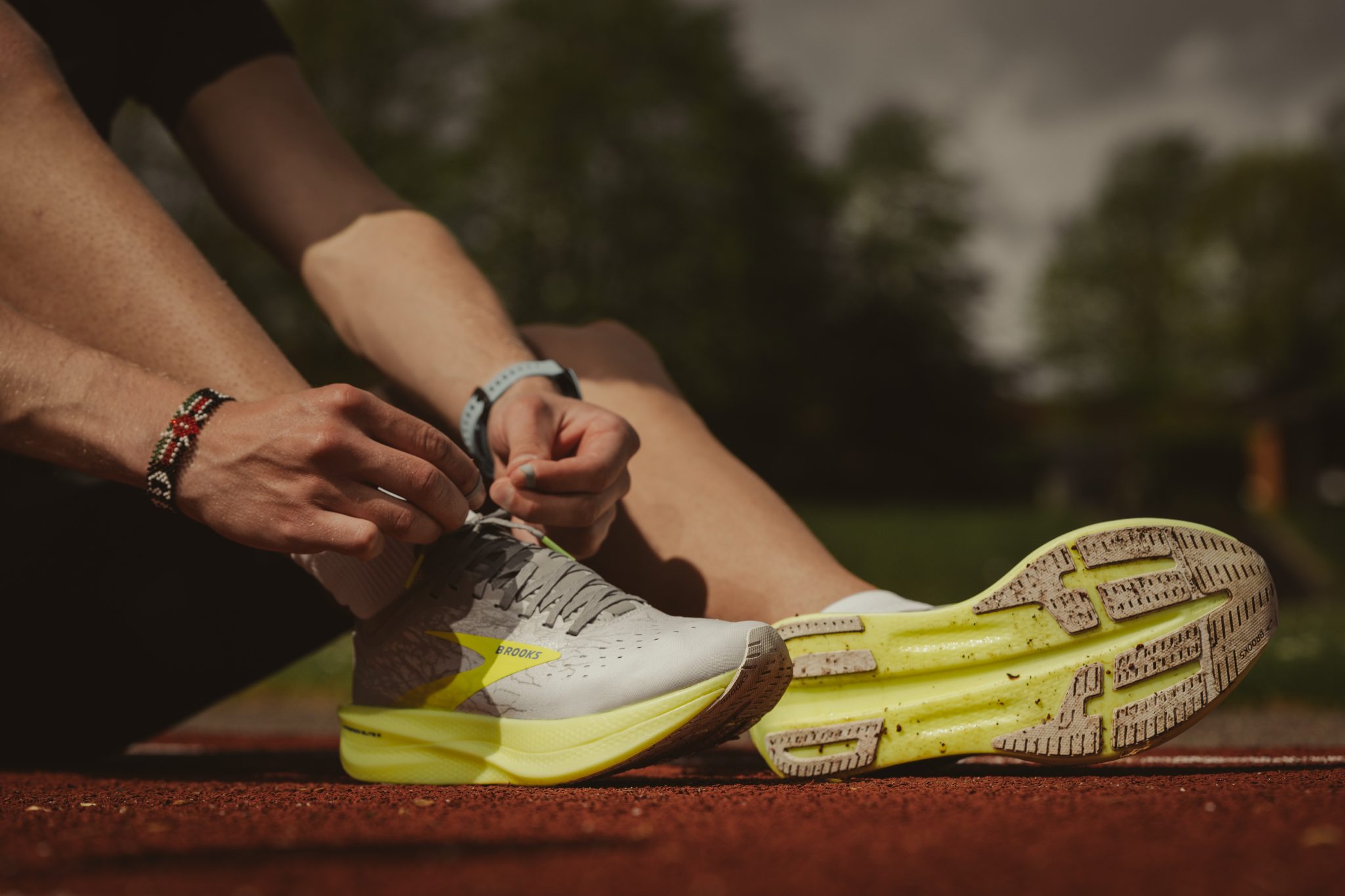
Flip an old pair of running sneakers upside down and set them on a flat table. Where the rubber tread is worn smooth tells you everything about your pronation mechanics:
- Neutral Pronation (S-Shaped Wear): Your foot touches down on the outer lateral edge of the heel, rolls inward by roughly 15 degrees to absorb impact naturally, and pushes off evenly across the ball of the foot. You’ll see wear on the outer heel corner and dead-center under the forefoot.
- Overpronation (Inner-Edge Wear): Common in runners with flexible arches or flat feet. After impact, the arch collapses inward too far, twisting the tibia and stressing the plantar fascia. Look for stability shoes featuring dual-density medial posts, J-Frame support, or holistic GuideRails so your ankles don’t roll inward.
- Supination / Underpronation (Outer-Edge Wear): Common in runners with rigid high arches. The foot stays locked on its outside edge from heel strike through toe-off, concentrating impact shock onto the fifth metatarsal and iliotibial (IT) band. Prioritize plush, flexible neutral midsoles without stiff medial posts.
3. Midsole Cushioning vs. Heel-to-Toe Drop Explained
Two numbers on a shoe’s spec sheet dictate how your joints feel on pavement: Stack Height (how many millimeters of EVA, TPU, or nitrogen-infused PEBA foam sit under your foot) and Heel-to-Toe Drop (the height difference between the heel and forefoot). A traditional 10mm to 12mm heel drop elevates the heel slightly, taking tension off tight Achilles tendons and calves—which is why podiatrists frequently recommend higher-drop stability trainers for plantar fasciitis relief.
Conversely, low-drop shoes (0mm to 5mm) encourage a midfoot strike and transfer more workload to your calves and ankles, while flat, firm platforms work best when you’re lifting on a gym floor—see our guides to the best cross-training shoes for men and best cross-training shoes for women if you split your time between the treadmill and the squat rack.
🏃 Elena’s Trackside Notebook: The 350-Mile Midsole Compression Check (Before Your Knees Feel It)
Runners often wait until the rubber outsole wears through to the foam before retiring a pair of shoes, but standard EVA midsole foam loses 30% to 40% of its shock absorption well before the tread looks bald—usually between 300 and 450 miles. I tell my athletes to look for horizontal creasing lines along the side of the midsole and perform the thumb-press test: if the foam under the heel feels rock-hard and doesn’t rebound after you press your thumb into it, retire that pair to lawn-mowing duty before your shins start aching.
4. Frequently Asked Questions About Running Shoe Fit
Should I buy running shoes a half size bigger than my casual dress shoes?
Yes. Almost every runner needs to go up a half size (and sometimes a full size) from their street-shoe measurement. During a run, your foot elongates on every landing and swells with heat; if you don’t leave that extra half-inch of toe box clearance, you’ll risk painful subungual hematomas (black toenails) and forefoot blistering.
How do I lock my heel in place without lacing the midfoot too tight?
Use those extra top eyelets at the very collar of your running shoes to tie a “Runner’s Loop” (also called a Heel Lock). Thread each lace straight into the top hole on the same side to create two small vertical loops, cross the laces over to the opposite loop, and pull downward. That’ll cinch the ankle collar snugly around your heel bone without squeezing the sensitive tendons across your instep.