
If you’ve ever played on an unlevel, lightweight department-store foosball table, you already know the frustration: dead spots where the ball sits stranded in the corners, sluggish rods that bind inside cheap plastic bushings, and flimsy legs that walk across the basement floor the moment a match gets competitive.
Table soccer is a mechanical game governed by cabinet inertia, rod tolerances, and toe-to-ball friction. When a table has real mass and precision bearings, you can trap fast passes cleanly, set up crisp front-pin and snake shots, and bank angles off the side aprons with repeatable accuracy. When a table is underbuilt, every match devolves into wild handle spinning.
Whether you’re outfitting a family basement for weekend game nights, furnishing a covered outdoor patio, or investing in an ITSF-certified tournament tank, we’ve evaluated and ranked the 6 best foosball tables for 2026—verified for cabinet weight, rod construction, and real-world owner durability.
Comparison Table: Best Foosball Tables at a Glance
| Model | Product & Award | Key Spec / Category | Tier | Action |
|---|---|---|---|---|

|
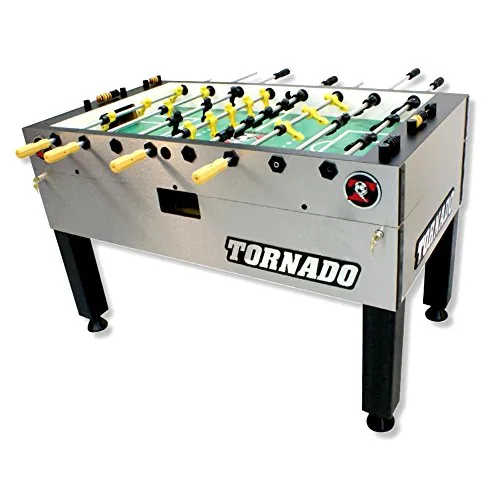
Best Tournament Benchmark Tornado Tournament 3000 |
355 lbs | 3/4-Inch Playfield & Split Cabinet | $$$$ | Check Price » |

|
Best Value Home Table KICK Titan 55-Inch Tournament Table |
148 lbs | 5/8-Inch Solid Steel Rods & 1-or-3 Goalie | $$$ | Check Price » |

|
Best Outdoor Patio Pick Garlando G-500 Weatherproof (50-Inch) |
172 lbs | Marine Multi-Layer Plywood & Anti-Rust Hardware | $$$$ | Check Price » |

|
Best Furniture-Grade Cabinet Hathaway Primo 56-Inch Foosball Table |
130 lbs | Counterbalanced Men & 5/8-Inch Solid Steel Rods | $$$ | Check Price » |

|
Best Mid-Range Arcade Pick Hall of Games 56-Inch Arcade Foosball Table |
91.5 lbs | 5/8-Inch Hollow Steel Rods & 5-Inch Levelers | $$ | Check Price » |

|
Best Budget Starter Pick Best Choice Products 54-Inch Regulation Table |
73 lbs | Contoured Grips & Built-In Cup Holders | $ | Check Price » |
🎯 Target & Range Notes: Counterbalanced Men vs. Traditional Figures: Why Singles Players Must Care
If you plan to play 1-on-1 matches, counterbalanced men aren’t a luxury—they’re essential. On traditional budget figures, the player’s head is lighter than the feet. When you rotate your 5-man midfield rod horizontal to clear a shooting lane for your rear defensemen, gravity immediately drops the feet back down to vertical, blocking your own shot. Counterbalanced figures (found on the Tornado T-3000, KICK Titan, and Hathaway Primo) have weights molded into the head that equalize the feet. You can flip your midfielders horizontal, take your hand off the grip, and they’ll stay parked flat while you fire from your defensive two-bar.
Detailed Reviews of the Best Foosball Tables
Tornado Tournament 3000
Price Tier: $$$$ | Key Spec: 355 lbs | 3/4-Inch Playfield & Split Cabinet
Ask any competitive table soccer player in North America to name the definitive standard, and you’ll get one answer: the Tornado Tournament 3000 (T-3000). Built in Richland Hills, Texas, the T-3000 is the official certified tournament table of the Tornado National Tour and the International Table Soccer Foundation (ITSF). Tipping the scales at a massive 355 pounds (56″ L x 30″ W x 36″ H) with a commercial-grade split cabinet and a 3/4-inch playfield, this table won’t budge an eighth of an inch even during full-power five-bar passing and bank shots. Its patented counterbalanced men feature redesigned, cross-hatched square feet for pinpoint front-pin, back-pin, and snake shot execution, while the chrome-plated, heat-treated hollow steel rods and commercial split bearings let you flick shots with zero rod flex.
Tournament veterans and serious rec-room owners agree that once you play on a T-3000, every retail table feels like a toy—specifically praising the dead-solid 355-pound mass and the way the 8-sided molded handles stay tacky without wraps. Owners do warn that moving the split cabinet down a basement staircase takes at least three adults, and you should confirm whether you’re ordering the 1-man or 3-man goalie layout for your preferred ruleset.
✓ What Works Well
- Official ITSF and Tornado National Tour table with an unshakeable 355 lb commercial split cabinet
- Patented counterbalanced players with sharp, cross-hatched feet allow surgical ball pinning and passing
- Heat-treated hollow chrome-plated steel rods and split bearings deliver effortless wrist speed and fast maintenance
⚠ What to Keep in Mind
- Commercial-tier investment meant for serious competitors, arcades, and flagship game rooms
- Massive 355 lb cabinet requires 2 to 3 adults to carry and level safely
Bottom Line: The undisputed benchmark for tournament players and flagship rec rooms where commercial ball control and zero-flex rods are non-negotiable.
KICK Titan 55-Inch Tournament Table
Price Tier: $$$ | Key Spec: 148 lbs | 5/8-Inch Solid Steel Rods & 1-or-3 Goalie
For families and rec-room hosts who want adult-proof stability without paying commercial coin-op prices, the KICK Titan 55-Inch hits the sweet spot. Listed at 148 pounds in Amazon’s catalog (and quoted even heavier on KICK’s factory spec sheet, measuring 55″ L x 30″ W x 36″ H) with a reinforced manufactured-wood cabinet and a 1/2-inch thick scratch-resistant playing field, the Titan has enough mass to absorb spirited doubles matches without walking across hardwood floors. It uses eight 5/8-inch solid chrome-plated steel rods with non-slip wooden handles, and ships with two full sets of players—26 counterbalanced men AND 26 traditional uniformed men—plus a convertible 1-man or 3-man goalie setup with corner ramps so you can customize how your table plays.
Homeowners consistently praise the Titan’s heavy-duty feel and love that KICK includes both counterbalanced and standard figures plus six balls right in the box. Long-term buyers note that the 5/8-inch solid steel rods are virtually impossible for teenagers to bend, though you’ll want to set aside two full hours with a partner to pin all 26 players and align the bearings during initial setup.
✓ What Works Well
- Sturdy ~148 lb reinforced cabinet and 1/2-inch playfield stay planted during competitive adult matches
- Includes both 26 counterbalanced players and 26 uniformed players, plus convertible 1-man or 3-man goalie setups
- Eight 5/8-inch solid chrome-plated steel rods with natural wooden handles resist bending under heavy family use
⚠ What to Keep in Mind
- Solid 5/8-inch steel rods carry more rotational weight than thin-wall hollow tournament rods
- Pinning 26 players and installing bearings takes roughly two hours of patient two-person assembly
Bottom Line: Our favorite all-around home rec-room table—delivering counterbalanced singles play, a convertible goalie layout, and nearly 150 pounds of stability.
Garlando G-500 Weatherproof (50-Inch)
Price Tier: $$$$ | Key Spec: 172 lbs | Marine Multi-Layer Plywood & Anti-Rust Hardware
If your game space sits on a screened porch, poolside cabana, or damp coastal basement, a standard indoor MDF table will absorb moisture, swell at the seams, and buckle within a single humid summer. The Garlando G-500 Weatherproof is engineered in Italy specifically to survive outdoor exposure. Instead of particle board, both the 50-inch cabinet and the playfield are constructed from high-quality marine multi-layer plywood sealed with waterproof plastic laminate and fade-resistant silkscreened field lines. Its anti-rust treated hardware, varnished steel legs with levelers, and 172-pound frame shrug off damp patio air, and it even ships with 10 foosballs and a protective vinyl storage cover.
Patio and beach-house owners report that the G-500 Weatherproof plays fast and stays dead-flat through multiple seasons of humidity that ruined their previous indoor tables, especially if you throw the included vinyl cover on after matches. Players used to American Tornado tables do point out that Garlando’s European-style players and brisk waterproof laminate favor quick one-touch passing and bank shots over slow American front-pin trapping.
✓ What Works Well
- Marine multi-layer plywood cabinet and playfield coated in waterproof laminate resist warping and humidity
- Anti-rust treated hardware and anti-scratch varnished steel legs with levelers handle covered patios and decks
- Ships complete with 10 balls, side ball returns, abacus scorers, and a protective outdoor vinyl cover
⚠ What to Keep in Mind
- European playfield laminate and player toe profile play faster with less bite for American pin shots
- Compact 50-inch cabinet length is slightly shorter than 56-inch North American tournament tables
Bottom Line: An Italian-built marine-plywood workhorse engineered specifically for covered patios, poolside cabanas, and humid coastal rec rooms.
Hathaway Primo 56-Inch Foosball Table
Price Tier: $$$ | Key Spec: 130 lbs | Counterbalanced Men & 5/8-Inch Solid Steel Rods
When you want a full-size 56.5-inch table that blends into a finished basement or den rather than looking like a neon arcade box, the Hathaway Primo 56-Inch hits the mark. Weighing 130 pounds (56.5″ L x 29″ W x 34″ H) with a rich wood-grain melamine finish, cross-supported playfield, and reinforced legs with adjustable levelers, it feels reassuringly solid during four-player family matches. Crucially, Hathaway didn’t skimp on the playing hardware: the Primo pairs 5/8-inch chrome-plated solid steel rods and E-Z spin bearings with counterbalanced ABS players that stay parked horizontally when you clear shooting lanes in 1-on-1 games, plus eight ergonomic wood handles and four recessed stainless-steel drink holders.
Families upgrading from sub-80-pound starter tables love the Primo’s furniture-style wood-grain cabinet, wooden handles, and true counterbalanced men—noting that two adults can assemble it in about 80 minutes with the included hex wrench. Owners do recommend picking up a couple of urethane tournament foosballs, since the two included 36mm plastic balls play a bit slick and bouncy on the melamine surface.
✓ What Works Well
- 130 lb cross-supported cabinet in a scuff-resistant wood-grain melamine finish looks great in finished dens
- Counterbalanced ABS players stay horizontal for singles play on 5/8-inch solid chrome-plated steel rods
- Includes eight ergonomic wooden handles, E-Z spin bearings, leg levelers, and four stainless-steel cup holders
⚠ What to Keep in Mind
- Included 36mm smooth plastic balls are fast and slick—upgrading to textured urethane balls improves pinning
- Backed by a 180-day limited warranty rather than KICK’s lifetime parts coverage
Bottom Line: A handsome 130-pound wood-grain table that gives finished basements genuine counterbalanced men, solid steel rods, and wooden grips.
Hall of Games 56-Inch Arcade Foosball Table
Price Tier: $$ | Key Spec: 91.5 lbs | 5/8-Inch Hollow Steel Rods & 5-Inch Levelers
If you want the fast wrist-flick speed of hollow 5/8-inch steel rods and a full 56-inch arcade footprint without spending into the upper mid-tier, the Hall of Games 56-Inch Arcade Table hits that mark cleanly. Tipping the scales at 91.5 pounds (56″ L x 28.75″ W x 34.5″ H), it reinforces its two-toned black-and-gray PVC-laminated MDF legs with full-panel end supports and oversize 5-inch adjustable leg levelers so the 12mm thick playfield stays flat on uneven basement concrete. Because the 5/8-inch steel rods are hollow rather than solid bars, younger players and casual adults can snap passes and shift defensively with much less wrist strain, and the 26 weighted robot-style burgundy-and-black players snap onto the rods without tools.
Parents of middle- and high-schoolers consistently highlight the snap-on tool-free player installation—which cuts assembly time nearly in half—and praise how smoothly the hollow rods glide through the plastic bearings once lubricated with silicone. However, because the cabinet weighs 91.5 pounds with a 12mm PVC-laminated MDF playfield, heavy-handed adult players note that it can shift slightly on bare tile if four adults lean hard into pull shots.
✓ What Works Well
- Lightweight 5/8-inch hollow steel rods with octagonal non-slip grips deliver quick rod acceleration
- Tool-free snap-on weighted player assembly saves significant setup time compared to traditional roll pins
- Full-panel leg supports and wide 5-inch leg levelers stabilize the 56-inch cabinet on uneven floors
⚠ What to Keep in Mind
- 12mm PVC-laminated MDF playfield and plastic slide bearings play faster and less grippy than 3/4-inch tournament laminates
- At 91.5 lbs, it’s sturdier than entry tables but lighter than 130+ lb semi-pro cabinets
Bottom Line: The smart mid-range pick for families who want a full 56-inch arcade table with fast hollow rods and painless tool-free player assembly.
Best Choice Products 54-Inch Regulation Table
Price Tier: $ | Key Spec: 73 lbs | Contoured Grips & Built-In Cup Holders
If you’re shopping for an affordable holiday gift for elementary or middle schoolers and don’t want to drop serious cash on a heavy furniture cabinet, the Best Choice Products 54-Inch Regulation Table is the most practical entry-level stand-alone table on the market. Measuring 54″ L x 28″ W x 34.25″ H and weighing 73 pounds, it skips flimsy tabletop gimmicks in favor of a waist-high composite wood cabinet in a warm walnut finish, chrome-finished steel rods, contoured plastic handles, and built-in cup holders at both ends. At 73 pounds, two parents can easily slide it into the corner of a playroom when the kids need floor space, yet it gives young players a genuine full-field 11-on-11 game.
Parents buying a first foosball table for 7-to-13-year-olds love the budget-friendly price tier and report that kids get hundreds of hours of after-school fun out of it. At the same time, experienced owners are candid about its limits: at 73 pounds with thin composite legs and non-counterbalanced men, it’s built for kids and casual family rallies—not aggressive adult bar-league players who yank hard on the rods.
✓ What Works Well
- Accessible entry-level price tier for a full 54-inch stand-alone table rather than a miniature tabletop toy
- Contoured plastic handles and waist-high 34.25-inch cabinet height fit kids and pre-teens comfortably
- Includes built-in end cup holders, bead scorers, and two balls for immediate family play
⚠ What to Keep in Mind
- Lightweight 73 lb composite cabinet will slide if adults play aggressively; figures aren’t counterbalanced
- Thin playfield and hollow rods require gentle recreational use to prevent bowing over time
Bottom Line: An unbeatable budget starter table for kids and casual family game nights that delivers full-size stand-alone fun without a big-ticket price tag.
🎯 Target & Range Notes: Table Care: Never Use WD-40 on Bearings or Ammonia on Playfields
Three maintenance mistakes ruin more home foosball tables than hard play. First, never spray WD-40 or petroleum aerosol oil into the rod bearings—petroleum solvents dissolve nylon split bushings and leave a gummy sludge that traps dust. Use only 100% pure liquid silicone (two drops on each steel rod outside the bumpers once a month). Second, when wiping down your playfield, never use household window cleaners containing ammonia (like Windex), which strips the friction coating off high-pressure laminates; use a lightly damp microfiber cloth followed by dry buffing (or rubbing alcohol on stubborn ball marks). Third, check your leg-leveler lock nuts every three months—aggressive lateral rod movement naturally shakes threaded levelers loose over time.
Other Foosball Tables We Evaluated
We evaluated several other popular models during our research. While capable for everyday sessions, each was edged out by our top award picks due to specific engineering trade-offs in hardware integration, long-term durability, or price-to-performance value:
Why it missed the cut: Delivers Tornado’s 1.5-inch thick black suede cabinet, patented split bearings, counterbalanced men, and natural wood handles at a slightly lighter weight (~225 lbs with side ball return) than the 355-pound split-cabinet Tournament 3000.
Why it missed the cut: The best space-saving pick (60 lbs, 48″ L x 24″ W x 32″ H) with folding legs and rolling caster wheels for apartments or multi-use rooms, though its compact 48-inch frame isn’t built for full-force adult doubles play.
Why it missed the cut: A sharp-looking 75-pound starter table with step-by-step video assembly instructions, four balls, and cup holders—very similar in stability to the Best Choice Products 54-inch table at a slightly higher retail tier.
Foosball Table Selection Guide: 5-Pillar Rec Room Buyer’s Playbook
Buying a full-sized foosball table turns a basement, garage, or office breakroom into an instant social hub—but consumer tables vary wildly in engineering quality. Entry-level boxes often look impressive in studio photos while hiding thin composite side walls and unbalanced figures that frustrate older players. Walk through these five structural pillars before ordering.
1. Cabinet Mass, Sidewall Thickness & Playfield Rigidity
Total assembled weight is the single most reliable indicator of how a foosball table will hold up over five years of play. Competitive foosball generates sudden lateral jarring every time a player executes a pull shot or stops a rod against the rubber bumpers. A table weighing 60 to 80 pounds is fine for young kids, but if four adults play doubles on it, the entire cabinet will slide across hardwood or carpet.
For mixed family and adult game rooms, target a cabinet weight between 130 and 175 pounds (like the Hathaway Primo or KICK Titan), and step up to 225 to 355 pounds (Tornado Classic II or T-3000) for tournament-level play. Pay close attention to playfield and apron thickness as well: a 1/2-inch to 3/4-inch cross-supported MDF or marine-plywood playfield prevents the center of the pitch from sagging over time, while 1-inch to 1.5-inch thick cabinet sidewalls keep the opposite rod bearings aligned so rods don’t bind.
2. Rod Engineering (Hollow vs. Solid Steel) & Player Toe Geometry
The steel rods and player figures are your direct mechanical interface with the ball. When comparing spec sheets, you’ll see two distinct rod architectures:
- Hollow High-Tensile Steel Rods (Tournament & Fast-Action Standard): Used on the Tornado T-3000 (heat-treated commercial hollow steel) and mid-range arcade tables like the Hall of Games 56-Inch. Hollow rods cut rotational inertia by roughly 25% to 35% compared to solid bars, letting you snap wrist flicks, execute rollover snake shots, and shift defensively without forearm fatigue.
- Solid 5/8-Inch Chrome-Plated Steel Rods (Heavy-Duty Home Standard): Found on the KICK Titan 55-Inch and Hathaway Primo 56-Inch. While solid steel bars feel slightly heavier during rapid wrist-flick shots, they’re virtually indestructible in family basements where kids and teenagers occasionally lean their body weight onto the handles.
Equally important is the shape of the player’s foot. Cheap tables use smooth, narrow, rounded toes that cause the ball to squirt away when you try to trap it. Look for counterbalanced men with wider, cross-hatched toes (and pair them with textured 35mm–36mm urethane foosballs rather than slick injection-molded plastic balls) so you can pin the ball dead under the rod and pass cleanly between figures.
3. Goalie Configuration (1-Man vs. 3-Man) & Room Footprint
Before assembling your table, decide which defensive layout matches your household’s style of play and verify your room dimensions:
- 3-Man Goalie Layout (North American Standard): Three figures sit on the rear goalie rod—one goalkeeper in the center and two wing defenders that sweep the flat back corners so the ball never stops out of reach. This keeps rallies moving fast and is the standard on North American Tornado tour tables.
- 1-Man Goalie Layout (European Ramped Corner Standard): A single goalie defends the net while sloped corner ramps roll balls back into play automatically. Tables like the KICK Titan 55-Inch include both the corner ramps and extra players so you can convert between 1-man and 3-man setups anytime.
- Minimum Room Clearance (8′ x 9′ Rule): While a regulation foosball cabinet measures roughly 55 to 56 inches long by 30 inches wide, fully extended rods add another 20+ inches of width on each side (70 inches rod-to-rod on a Tornado T-3000). Always allow an 8-foot by 9-foot floor perimeter so players can step back and pull rods fully out without punching holes in nearby drywall.
4. Price-Tier Reality Check ($, $$, $$$, $$$$)
Foosball tables divide cleanly into four price tiers based on cabinet weight, bearing precision, and moisture resistance:
- Entry Family & Youth Starter Tier ($): 60 to 80 lb composite tables (like the 73 lb Best Choice Products 54-Inch). Great for kids, pre-teens, and casual holiday fun, but the lightweight frame and non-counterbalanced men aren’t meant for heavy adult power shots.
- Mid-Range Arcade & Space-Saving Tier ($$): 85 to 100 lb arcade tables with hollow 5/8-inch steel rods and oversize levelers (Hall of Games 56-Inch) or vertical-folding apartment tables on caster wheels (KICK Monarch 48-Inch).
- Heavy Home & Furniture Tier ($$$): The sweet spot for most finished basements (KICK Titan 55-Inch and Hathaway Primo 56-Inch). You get 130 to 150 lb cabinets, counterbalanced figures, wooden handles, and 5/8-inch solid steel rods that handle aggressive adult doubles.
- Commercial Tournament & Marine Outdoor Tier ($$$$): 355 lb ITSF-certified split-cabinet tanks (Tornado Tournament 3000) or Italian marine-plywood weatherproof tables built for covered outdoor patios (Garlando G-500 Weatherproof).
5. Leveling Protocol, Pure Silicone Care & Patio Protection
Even a commercial tournament table plays poorly if the pitch sits half a degree off-level. During initial assembly, apply a drop of removable blue threadlocker (such as Loctite) to the main leg bolts so aggressive lateral pull-shot impacts don’t vibrate the legs loose over time. Once your table is in its permanent spot, place a 12-inch carpenter’s level directly on the center of the playfield—first lengthwise parallel to the side aprons, then crosswise between the goals—and thread the leg levelers up or down until the bubble sits dead-center. Tighten the leveler lock nuts against the leg base, and re-check them every three months.
For routine rod care, apply two drops of 100% pure liquid silicone lubricant (such as FoosJuice) onto each steel rod just outside the rubber bumpers once a month, slide the rod in and out to coat the bearing sleeve, and wipe away any excess. Note that brand-new textured urethane tournament foosballs feel slightly slick for the first few hours until they pick up a microscopic patina of playfield friction, after which front-pin grip improves dramatically. Clean high-pressure laminate playfields with a damp microfiber cloth—never ammonia glass cleaners, which strip surface grip—and keep indoor MDF tables strictly inside climate-controlled rooms.
Frequently Asked Questions About Foosball Tables
How much room space do you need around a full-size foosball table?
Although a standard table cabinet measures roughly 55 to 56 inches long by 30 inches wide, pulling the rods all the way out expands the total width to nearly 6 feet. Plan for at least an 8-foot wide by 9-foot long floor area so two to four adults have elbow room to maneuver without hitting walls or furniture.
What is the difference between counterbalanced and non-counterbalanced foosball men?
Counterbalanced players have weight molded into the head of the figure to balance the weight of the feet. When you play 1-on-1 singles and rotate your 5-man midfield rod horizontal to open a clear shooting lane from your back defensemen, counterbalanced men stay parked horizontal instead of flopping back down under gravity and blocking your own shot.
Can you put a regular foosball table in a garage or covered patio?
Not if it’s built from standard MDF or particle board. Ambient humidity and overnight temperature swings cause indoor MDF playfields to swell, warp, and delaminate within a single season. For covered patios, screened porches, or unheated garages, choose a marine-grade plywood table sealed with waterproof laminate like the Garlando G-500 Weatherproof.
Why shouldn’t you use WD-40 to lubricate foosball rods?
WD-40 and household aerosol oils contain petroleum solvents that soften nylon bushings, degrade rubber bumpers, and leave behind a tacky film that attracts dust and grit—eventually making the rods bind worse than before. Always use 100% pure liquid silicone foosball lubricant.
Are hollow steel rods better than solid steel rods?
High-tensile hollow steel rods (found on commercial Tornado tables) are lighter and faster than solid steel rods, reducing wrist fatigue and increasing shot speed on snake and wrist-flick shots. However, thick 5/8-inch solid chrome-plated steel rods (like those on the KICK Titan and Hathaway Primo) are exceptionally resistant to bending if kids hang or lean on the handles, making both great choices depending on your household.